COMMUNICATIONS MITTEILUNGEN
FROM THE DER
KONKOLY OBSERVATORY STERNWARTE
OF THE DER UNGARISCHEN AKADEMIE
HUNGARIAN ACADEMY OF SCIENCES DER WISSENSCHAFTEN
BUDAPEST - SZABADSAGHEGY
No. 90.
(Vol. 10, Part 4)
THE LIGHT CURVE OF V441 HERCULIS
GUSTAV A. BAKOS
(Department of Physics, University of Waterloo,
Waterloo, Ont., Canada)
BUDAPEST, 1987
ISBN 963 8361 27 1
HU ISSN 0324 - 2234
THE LIGHT CURVE OF V441 HERCULIS
ABSTRACT
The light variations of the F-type supergiant V441 Her have been followed
for a period of five years in the B and V pass bands. A pulsation period of
63.9 days has been derived. The residuals show a harmonic distribution with a
period of about 1500 days. Arguments are presented in favour of a circumstellar
envelope around the F-type star and an infrared companion to this star.
INTRODUCTION
V441 Her (89 Her, HD 163506) is a relatively bright star (V = 5.45) of
spectral type F2eIa and an absolute visual magnitude of -7.1 (Searle et al.,
1963). A light curve with an amplitude of 0.1 mag. and a period of about 70
days has been derived by Worley (1956). Variations in radial velocities have
been noted by Campbell and Moore (1928). Spectroscopic orbital elements were
derived by Ferro (1983) with a period of 286 days. During the last ten years
the star has been the subject of numerous photometric observations by Percy et
al. (1979), Burki et al. (1980), Fernie (1981) and Percy and Welch (1981). The
present author has discovered the star accidentally by choosing it as a
comparison star in a program of photoelectric observations of some visual
binaries.
As has already been pointed out, spectroscopic observations yield a
period of 286 days for the radial velocity variations. From orbital elements
derived by Ferro (1983) it appears that a massive primary star of 20 solar
masses has a companion of about 2 M_sun at a distance of nearly 3 AU. A line
splitting of the H and K lines, of HBeta and of the D lines has been observed
indicating a presence of a circumstellar envelope (Gillett et al., 1970). From
IUE high resolution ultraviolet spectra Lamb and Neese (1982) have found
evidence for mass loss from the star. On the other hand Humphreys and Ney
(1974) concluded that 89 Her may be a binary system having an infrared star at
a distance of about 9 AU.
OBSERVATIONS
The present series of photometric observations has started in the spring
of 1981 and continued yearly, with the exception of one year (1985) until the
summer of 1986. The observations were made with the 0.3 m reflector of the
University of Waterloo equipped with a thermoelectrically cooled photometer
and an EMI 9844B photomultiplier tube. The observations were made in the B and
V pass bands. On each night a series of measurements of the comparison star,
the variable and the check star were made. The variable was compared with the
star HD 165908 of spectral type F7V and checked against the star HD 162555 of
spectral type K1III. A differential extinction correction has been applied to
the observations. The following magnitude difference between the comparison
star and the check star has been derived:
B = -0.974m V = -0.532m
+-0.003 +-0.003
The light curve of V441 Her is that of a small amplitude pulsating
variable with a period given by a number of authors as 63 to 72 days. From
sources listed above 17 epochs of maximum brightness have been extracted and a
least squares solution performed to derive corrections to the assumed zero
epoch, the period and its derivative. The following elements have been
obtained:
Max. = J.D. 2444395.1723 + 63.93296d x E + 0.000067914d x E^2
+-.0027 +-.00012 +-.000000008 (m.e.)
The photoelectric observations made at Waterloo have been listed in Table I
while the epochs of maxima used in derivation of the period have been
reproduced in Table II. The residuals from the above ephemeris, especially
those of the last ten years exhibit an oscillation in the range of +-20 days
with a period of about 1950 days (the average separation between maxima and
Table I
Photoelectric observations of V441 Her
J.D. Phase V B-V J.D. Phase V B-V
2440000+ 244000+
4745.854 0.4661 5.336 0.531 5540.665 0.7384 5.248 0.463
4760.792 0.6989 5.289 0.495 5549.601 0.8767 5.242 0.457
4773.724 0.9004 5.240 0.499 5554.569 0.9536 5.255 0.480
4781.757 0.0255 5.268 0.484 5567.560 0.1391 5.309 0.478
4782.700 0.0402 5.256 0.496 5571.553 0.2009 5.294 0.518
4795.634 0.2418 5.302 0.511 5578.544 0.3090 5.338 0.483
4796.659 0.2577 5.308 0.508 5585.535 0.4172 5.356 0.491
4807.630 0.4287 5.368 0.534 5592.530 0.5254 5.318 0.522
4808.621 0.4441 5.355 0.539 5819.868 0.9314 5.252 0.492
4810.607 0.4750 5.350 0.534 5836.798 0.3390 5.338 0.525
4815.608 0.5530 5.338 0.534 5844.803 0.4638 5.352 0.498
4817.634 0.5845 5.317 0.531 5853.774 0.6037 5.318 0.499
4828.599 0.7554 5.244 0.474 5855.775 0.6350 5.328 0.485
4876.565 0.5003 5.351 0.551 5870.725 0.8681 5.252 0.470
4880.606 0.5632 5.344 0.550 5872.722 0.8992 5.252 0.469
4881.591 0.5786 5.308 0.550 5880.676 0.0233 5.245 0.492
4890.565 0.7184 5.276 0.500 5882.686 0.0346 5.252 0.472
4894.582 0.7809 5.238 0.526 5887.660 0.1322 5.264 0.489
5087.854 0.7720 5.246 0.497 5893.660 0.2258 5.289 0.496
5140.740 0.5943 5.328 0.532 5894.636 0.2410 5.297 0.491
5144.710 0.6560 5.290 0.519 5900.649 0.3348 5.329 0.487
5151.672 0.7642 5.258 0.543 5907.615 0.4434 5.330 0.498
5158.720 0.8738 5.246 0.506 5909.590 0.4742 5.316 0.515
5217.594 0.7819 5.223 0.479 5928.568 0.7707 5.267 0.519
5220.544 0.8278 5.217 0.479 5929.562 0.7856 5.259 0.473
5221.536 0.8432 5.240 0.482 5934.565 0.8637 5.244 0.458
5222.550 0.8589 5.242 0.484 5937.554 0.9103 5.215 0.463
5243.522 0.1766 5.311 0.497 6550.840 0.6796 5.270 0.506
5247.514 0.2386 5.322 0.502 6558.814 0.7436 5.219 0.527
5248.517 0.2542 5.365 0.489 6580.756 0.0858 5.255 0.528
5264.531 0.5022 5.320 0.531 6584.742 0.1480 5.287 0.522
5266.500 0.5335 5.323 0.509 6591.729 0.2570 5.319 0.536
5269.500 0.5800 5.316 0.540 6598.715 0.3659 5.361 0.540
5470.822 0.6570 5.277 0.506 6599.700 0.3813 5.362 0.531
5506.800 0.2140 5.311 0.503 6606.690 0.4903 5.353 0.531
5507.693 0.2278 5.314 0.481 6621.668 0.7238 5.284 0.503
5525.639 0.5057 5.308 0.513 6634.621 0.9258 5.266 0.502
5537.660 0.6918 5.265 0.452
minima). The distribution of residuals is shown in Figure 1a. Subsequently,
the residuals have been fitted to the following expression:
(O-C)_1 = A sin 2 pi (P_0/P_1 E - phi )
where P_0 is the pulsation period and P_1 is the period of oscillation while phi
is the phase shift. By the method of least squares the following elements have
Table II
Epochs of maxima of V441 Her and their residuals
J.D. Delta t E (O-C)_1 (O-C)_2 Source
2435308.72 -9087.024 -142 18.612 -8.015 Worley, 1956
5386.63 -9009.114 -141 32.398 5.995 -"-
8894.548 -5501.196 -86 12.937 3.274 Burki et al., 1980
2441398.675 -2997.069 -47 16.768 4.978 -"-
1458.519 -2937.225 -46 12.488 -0.198 -"-
3316.74 -1079.004 -17 11.107 5.787 Fernie, 1981
3452.487 - 943.257 -15 18.606 11.496 -"-
3689.705 - 706.039 -11 -0.673 -8.724 Percy et al., 1979
4060.656 - 335.088 -5 -14.467 -16.511 Fernie, 1981
4395.744 0 0 0 0.572 Percy and Welch, 1981
4455.592 59.848 1 -4.276 1.909 -"-
4522.528 126.784 2 -1.465 5.542 Ferro, 1983
4704.899 309.155 5 -11.466 -3.584 -"-
4773.724 377.980 6 -6.765 0.865 present paper
4828:599 432.855 7 -16.014 -8.887 -"-
4894.582 498.838 8 -14.156 -7.751 -"-
5221.536 825.792 13 -7.823 -6.768 -"-
5549.601 1153.857 18 -0.379 -2.745 -"-
5877.696 1481.952 23 7.095 7.475 -"-
5937.554 1541.810 24 2.829 4.450 -"-
6558.814 2163.070 34 -17.153 -3.645 -"-
6636.621 2240.877 35 -3.470 10.189 -"-
been derived:
A = 6.532d phi = 135.685deg
+-.012 +-.012 (m.e.)
The new residuals appear to have a more random distribution with a scatter of
about +- 10 days. The sum of the squares of the residuals has been reduced to
1083 from 3760. Some of the large residuals may have been produced by
inclusion of inadequately observed epochs of maxima.
The observations made between 1981-86 have been represented in terms of
the 64-day period, including the quadratic term in Figure 2a. The light curve
reached a maximum at phase 0.85 and a minimum at phase 0.40. Its amplitude is
0.12 mag. The individual points exhibit a scatter of about 0.02 mag. with
respect to the mean light curve. The colour index, B-V, shows a considerable
scatter. Therefore its mean value for every tenth of the phase interval has
been calculated and plotted in Figure 2b. The open circles represent the mean
of fewer than five points in a given phase interval. The plot shows that the
colour index changes with the light curve becoming bluer at the time of maximum
brightness of the light curve with, perhaps, a small phase delay as compared
with the light curve itself.
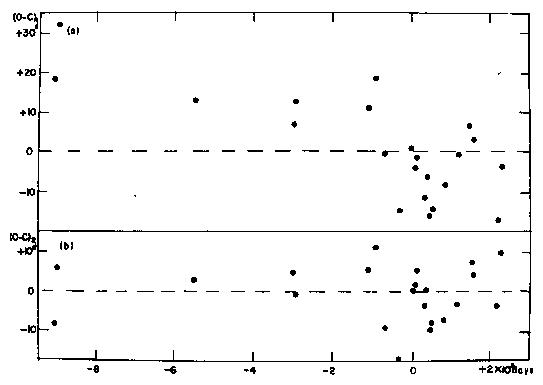 Figure 1a: The residuals (O-C)_1 of Table II including the quadratic term
of the ephemeris
1b: The residuals (O-C)_2 including the harmonic term
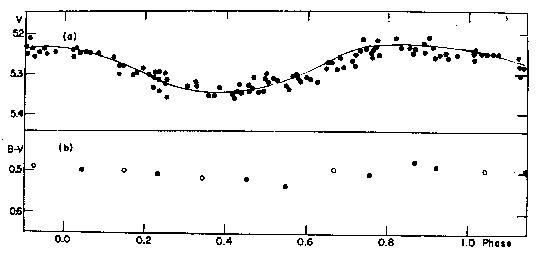 Figure 2a: The light curve of V441 Her
2b: The colour index (B-V) of V441 Her
DISCUSSION
In the preceding section it has been shown that the period of light
variations of 89 Her is variable and a second order term is required to
represent the light curve of the star over a long period of time. Coupled with
the line doubling of certain spectral lines observed by Bohm-Vitense (1956)
and more recently by Lamb and Neese (1982) an expansion velocity of about 200
km/s has been observed. This velocity may represent the escape velocity at
the stellar surface. It indicates an ejection of a gaseous shell and a
formation of a circumstellar envelope around the F-type supergiant. Sargent and
Osmer (1969) have estimated the mass loss to the envelope at about 10^-8
M_sun/year. In addition, Humphreys and Ney (1974) have measured an infrared
excess in the radiation of this star and concluded at the presence of a late
type supergiant having an orbital period in excess of 4 years. The distribution
of the residuals in Figure 1a confirms the presence of a star in the
system. By assuming the mass of the F-type supergiant to be about 20 M_sun, the
mass of the infrared star as 10 M_sun and the orbital period as 5.3 years (1950
days) the semimajor axis of the orbit is about 9.3 AU.
Thus we conclude that the system of 89 Her is at least a triple system
having a small mass component orbiting the F-type supergiant with a period of
285 days. At the same time the pulsating supergiant is loosing mass to a
circumstellar envelope. In addition there is a late type supergiant orbiting
the system with a period of about 5.3 years.
Most of the reduction work and preparation of the manuscript were done
while the author was visiting the Konkoly Observatory in Budapest. The
hospitality of Dr. Bela Szeidl is herewith acknowledged. This research was
supported by a grant from the Natural Sciences and Engineering Research Council
of Canada.
Budapest - Szabadsaghegy and Waterloo, 17 December, 1986
References:
Bohm-Vitense, E., 1956, Publ. Astron. Soc. Pacific 68.57
Burki, G., Mayor, M. and Rufener, F., 1980, Astron. and Astrophys. Suppl.
42.383
Campbell, W.W. and Moore, J.H., 1928, Publ. Lick Obs. 16.260
Fernie, J.D., 1981, Astrophys. J. 243.576
Ferro, A.A., 1983, Study of Pulsation Properties of Small Amplitude Yellow
Supergiants, Thesis, Univ. of Toronto
Gillett, F.C., Hyland, A.R. and Stein, W.A., 1970, Astrophys. J. 162.L21
Humphreys, R.M. and Ney, E.P., 1974, Astrophys. J. 190.339
Lamb, S.A. and Neese, C.L., 1982, Bull. Am. Astron. Soc. 14.614
Percy, J.R., Baskerville, I. and Trevorrow, D.W., 1979, Publ. Astron. Soc.
Pacific 91.368
Percy, J.R. and Welch, D.L., 1981, Publ. Astron. Soc. Pacific 93.367
Sargent, W.L.W. and Osmer, P.S., 1969, Mass Loss from Stars, Ed. M. Hack,
p. 57, Reidel Publ. Comp. Dordrecht
Searle, L., Sargent, W.L.W. and Jugaku, J., 1963, Astrophys. J. 137.268
Worley, C., 1956, Publ. Astron. Soc. Pacific 68.62